

| Practice | What the evidence supports | Planning use |
|---|---|---|
| Transparent policy terms | Leaders should communicate hybrid policies transparently and make the “deal” clear. | Write down who is expected where and when, and what stays flexible, before the policy is announced. |
| Team-set in-person schedules | Business units and teams, not CEOs, determine in-person schedules. Every function has its own key times when being in the same room matters more. | Ask each function to name its moments of highest in-person value, then build the schedule around them. |
| Outcome-based measurement | Success is measured on outcomes, not activity or inputs. Monitoring hours or keystrokes makes it worse. | Agree objectives per role and drop activity tracking from performance reviews. |
| Personal connection in virtual meetings | The first five minutes of every virtual meeting are devoted to personal connection. | Build a short check-in into the standard meeting template so remote attendees are not treated as an afterthought. |
| Location-neutral expectations | Employees are expected to meet their objectives and deliver on their responsibilities regardless of where they are working. | Hold office days and remote days to the same performance standard. |
The table draws on MIT Sloan Management Review’s hybrid leadership advice and Accruent’s overview of the hybrid work model.
Hybrid work model best practices start with clear terms, team-level schedules and outcome-based measurement. The central condition is fairness: people working remotely and in the office need the same access to decisions, projects and recognition.
For wider context, see our coverage of remote work trends. The definition of the model itself is set out in What Does Hybrid Work Really Mean? A Practical Guide For Employees And Managers (2026) – Gozaik.
Consequences of vague hybrid terms
When a hybrid policy is loose, each manager fills the gaps differently, and presence in the office becomes an informal signal of commitment. That is the setting in which proximity bias, the tendency to favour colleagues who are physically nearby, takes hold. A summary of hybrid work practice notes that some hybrid employees worry they will be overlooked if they are not physically present, with promotions and big projects the usual concern. A policy that never addresses visibility leaves that worry unanswered.
MIT Sloan Management Review’s advice to senior teams is blunt: make the “deal” clear. In practice, that means leaders should decide a few things up front:
- Publish the terms. State where people are expected to work, which parts are fixed and which are negotiable. Employees can then plan without asking a manager to interpret the rules.
- Say how visibility is handled. Explain how promotion and project decisions are made so they do not depend on who happens to be in the room.
- Treat exceptions as part of the policy. If a team needs a different arrangement, record it and the reason, so it reads as a rule applied consistently and not as favouritism.
Clear terms only help if the schedule behind them fits the work, which is the next decision.
Choosing a schedule and office use policy
Fixed, partial-choice and full-choice patterns
Hybrid schedules usually set office days in one of three ways, according to the same hybrid work examples: the company fixes them, employees get partial choice, or employees choose freely with a minimum such as two office days per week. Each pattern suits a different situation.
- Company-set days. These suit functions where collaboration peaks are predictable and shared by everyone. They are simple to communicate, but they ignore differences between roles.
- Partial choice. This fits teams that need some shared days but have individual constraints. It needs a clear rule on how far the choice extends, or it drifts back into manager-by-manager discretion.
- Full choice with a minimum. This suits work that is largely individual and where the minimum protects a baseline of face-to-face time. Pair it with an attendance view so colleagues can find each other.
Who sets the pattern
MIT Sloan Management Review recommends that business units and teams, not CEOs, determine in-person schedules. It adds that every business function likely has its own key times when being in the same room is more meaningful. A company-wide rule is therefore a poor fit unless it leaves room for each function to anchor its office days to those moments.
A sensible office use policy sets the outer limits at company level, such as the principles and the exception route. It then delegates the actual days to the teams who know when collaboration pays off. Leaders who want a sales team and an engineering group on the same fixed days should first check that those days match each group’s own key times.
Keeping hybrid work fair
Fairness in hybrid work means that where someone works does not change what they can reach: decisions, interesting projects, feedback and promotion. Three habits support it.
- Use one yardstick. Judging people on objectives and responsibilities regardless of location, as Accruent’s description of outcome-based performance puts it, removes presence as a proxy for contribution.
- Make attendance visible, not judged. Workplace scheduling tools can show who is coming into the office and when. Used to plan shared days, that helps. Used to rank commitment, it recreates the problem it was meant to solve.
- Audit who gets the visible work. If big projects and promotions consistently go to the people who are in the office most often, the policy is not delivering the fairness it promises, whatever it says on paper.
The meeting room is where unfairness shows up first, so it deserves its own attention.
Equal participation in meetings and tools
A hybrid meeting is fair when a remote participant can see, hear and be heard as easily as someone seated at the table. That depends on the room setup and on how the meeting is run. The room needs a screen and camera that put remote colleagues in view. The facilitator then needs to treat them as full participants, not as an audience.
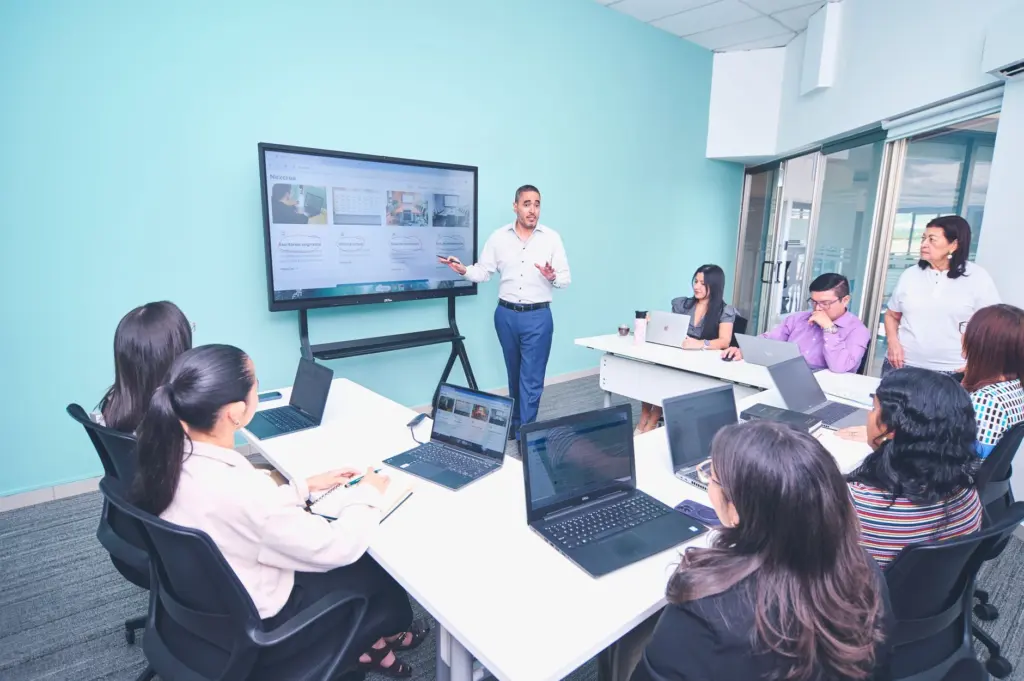
MIT Sloan Management Review also advises that the first five minutes of every virtual meeting be devoted to personal connection. Starting this way gives remote colleagues a chance to speak before the agenda takes over. It also builds the relationships that office-based teams pick up informally in corridors.
Tool choice matters less than agreement on how tools are used. Decide which channel serves which purpose, and apply that decision to everyone. Teams that are introducing AI features into their toolset can use How To Use AI In The Workplace: Practical Strategies To Boost Productivity And Reduce Risk In 2026 – Gozaik to weigh the productivity gains against the risks.
Measuring hybrid productivity
Hybrid productivity is best measured on results. MIT Sloan Management Review’s guidance is to measure success based on outcomes, not activity or inputs. It warns that monitoring hours or keystrokes makes things worse, because employees spend their time gaming the system. A tracking tool rewards looking busy and tells a leader nothing about whether the work is good.

Accruent’s account of outcome-based hybrid performance describes the same standard: employees are expected to meet their objectives and deliver on their responsibilities, regardless of where they are working. For a leader, three decisions follow from that.
- Define the outcomes per role. Agree what good looks like with each team in advance, so the measure is known before the work begins.
- Drop activity metrics. If login time, hours online or message counts feature in reviews, remove them and replace them with deliverables and results.
- Use the same measures on every day. Office days and remote days are judged by the same objectives, which also supports the fairness goal above.
Why people, processes and technology must line up
The practices above work together because hybrid work needs alignment across people, processes and technology. A fair policy depends on people who trust the terms. It also depends on processes, such as how schedules are agreed and how performance is assessed, that do not reward presence. Finally, it depends on technology that gives remote colleagues equal footing. If one of the three lags, the others carry the cost. A good scheduling policy cannot rescue meetings where remote staff cannot be heard.
Treat the first version of the policy as a working draft. Teams set their own schedules, so they are best placed to report which days deliver value and which do not. Review the policy at a regular interval, record what changes and why, and tell employees. A policy that visibly adapts to evidence is easier to trust than one presented as final.
Frequently asked questions
Which tools do hybrid teams commonly use?
Zoom, Slack and Microsoft Teams are common choices for instant messaging, video conferencing and file sharing. The tool matters less than agreeing on which channel is used for what.
How many types of hybrid work model are there?
A Zoom survey, reported by Archie, identified six different types of hybrid work model. Schedule rules, whether fixed, partly chosen or freely chosen, are the main way they differ.
Do hybrid teams perform worse than fully onsite teams?
MIT Sloan Management Review reports that hybrid teams enjoy more flexibility and work-life balance, and experience increased productivity and focus, compared with fully onsite workers.