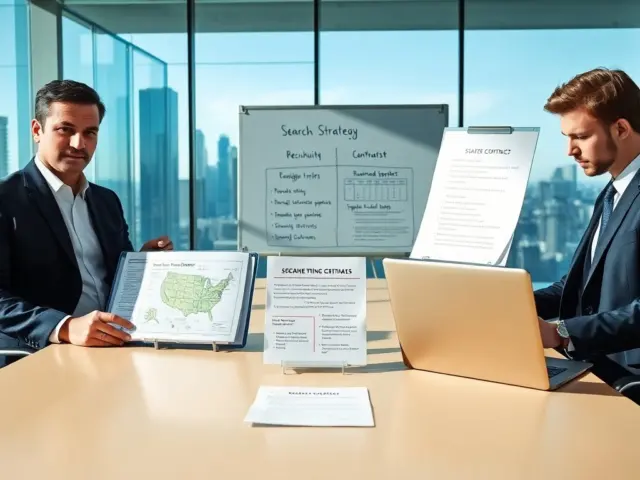

This guide explains how to conduct an interview well: use a standard format with identical questions for every candidate, score each answer against job-related criteria, and compare candidates only after all have interviewed.
The method below suits hiring managers and first-time interviewers. It also shows candidates what interviewers score. It is one part of the wider process of how to hire employees.
Why structure produces better interviews
A structured interview works because it removes the variation that makes candidates hard to compare. Colorado State University’s HR guidance says a standard, pre-established format with identical questions for all candidates promotes fairness. It adds that a standardized format built on job-related criteria helps candidates get evaluated equitably and consistently. If one candidate gets a relaxed conversation and another gets a tough technical grilling, the scores measure the interviewer’s mood rather than the candidates.
The same guidance sets a simple rule for the whole process: what you do for one candidate, do for the others. That covers questions, time allowed, materials and the way you record your impressions.
Interviewing is also a skill that improves. Harvard Business Review notes that like any other skill, job interviewing can be mastered with practice. A hiring manager who has never done it should still start with a fixed structure, because a script protects against improvising.
Stage one: define competencies before writing questions
Start with the job, not the questions. The University of Washington advises identifying and defining the specific competencies needed to perform the essential duties in each position. Competencies are not just about what a candidate knows. They describe how candidates apply what they know to the expectations of the job.
In practice, write a short list of the competencies the role really depends on, such as teamwork or problem-solving, and define each in plain language. Every question you later ask should map to one of them. A question that maps to nothing on the list is a candidate for deletion.
Stage two: choose and write the questions
Behavioral questions
Behavioral questions are the backbone of most structured interviews. MIT’s career office explains that behavioral interviewing aims to objectively measure a person’s past behavior as a predictor of future results. Colorado State recommends open-ended behavioral questions, with follow-up questions to clarify ideas when necessary. An example prompt from MIT: “Tell me about a time when you worked as part of a team to successfully execute a project.”
Candidates are likely to expect this format. Yale’s career office says most interviews are behavioral interviews, with questions asking for examples of past accomplishments. Prepared candidates will arrive with stories, so your skill lies in the follow-up questions and the scoring.
Keep every question job-related
Colorado State’s test is blunt: before asking a question, make sure it is essential to evaluating the candidate’s qualifications for the job. Everyone involved in the interviews should also review the list of appropriate and inappropriate questions beforehand. If you cannot say which competency a question measures, drop it.
Stage three: build the scoring rubric and scorecard
A scoring rubric turns impressions into evidence. The University of Washington’s guidance covers identifying competencies and questions and developing a scoring matrix, and it offers a sample interview matrix and a candidate decision matrix example as downloadable templates. Colorado State directs interviewers to use the candidate evaluation tool at each step, relying on job-related criteria, candidate responses and observed behavior.

The table below is a simple layout you can copy. It pairs each competency with its question, the evidence to listen for and a place for the rating and a written note.
| Competency | Question prompt | Evidence to listen for | Rating and note |
|---|---|---|---|
| Teamwork | Tell me about a time when you worked as part of a team to successfully execute a project. | Situation or task, the candidate’s own actions, the result of those actions | Rating against your written criteria, plus a short note quoting the evidence |
| Next competency from your role definition | A behavioral prompt written for that competency | The same situation, action and result structure | Rating and note |
| Overall evaluation | Not asked of the candidate | Job-related criteria, candidate responses and observed behavior | Written summary, with no comparison to other candidates yet |
The layout draws on the University of Washington’s competency-based interviewing guidance and Colorado State’s interviewing best practices.
How to score answers fairly
Score each answer when you hear it, and judge it against the criteria rather than against the previous candidate. Colorado State’s guidance says to wait to compare candidates until all have been evaluated against the criteria. Early comparisons let one strong or weak interview set the bar for everyone after it.
Look for a complete answer. The University of Washington says candidates should give complete answers, not generalized ones, and describes the target as a STAR response: the situation or task, the candidate’s actions and the result of those actions.
- Score the action, not the story. Listen for what the candidate personally did and why, since that is the part that predicts behavior in your role.
- Write evidence, not verdicts. A note such as “described a specific project and own contribution” can be checked later. “Seemed great” cannot.
- Apply the same scale to everyone. The rubric only works if the criteria stay fixed across all candidates.
What candidates can expect interviewers to score
Candidates can use the same logic in reverse. Interviewers are scoring evidence of the competencies the role needs, so a vague answer gives them nothing to record. MIT’s STAR guidance suggests a rough time split for an answer: situation 20%, task 10%, action 60% and result 10%. The heaviest share goes to what you personally did, which is also the part a rubric rewards.

For interviewers, this split is a useful check on your own follow-ups. If a candidate spends most of the answer on context, steer them back to their actions.
Candidate experience before and during the interview
A good candidate experience starts before the meeting. Colorado State advises planning the interview ahead of time and giving the candidate complete information in advance, including an agenda with the names and titles of the people they will meet. Candidates who know the format arrive prepared, and their answers become easier to compare.
If your applicant pool is thin, widen it before you schedule anything. Our guide on how to post a job on linkedin covers one way to do that.
During the interview, give people room to think. The University of Washington suggests telling candidates that a short pause is acceptable before they answer a behavioral question.
Running the interview
Open with the agenda, ask the planned questions in order, and write notes against the competencies as the candidate speaks. Use follow-up questions to draw out missing detail rather than to introduce new topics. Because the same steps apply to every candidate, a hiring manager can run each interview with the same checklist.
Share the work where you can. Colorado State advises involving at least one other person in the interview process, so that the evaluation never rests on a single opinion.
Documentation and legal limits
Write down every evaluation. Colorado State’s guidance requires that people in the process document their evaluation and assessment of each candidate in writing, and it keeps those records for a minimum of three years to comply with university and US Department of Labor records retention requirements. Check what applies in your own organization and jurisdiction.
Guard the questions you ask about health. The same guidance says medical information should not be accepted or retained, and that you should not ask disability-related questions before an offer of employment is made. Applicants with disabilities must be evaluated in terms of the actual job requirements. Competency-based questions already keep you on safe ground, because each one is tied to a duty of the role.
Decide, then hand over
Hold the debrief only after every candidate has been scored on the same criteria. Then compare the written evidence side by side and decide. Once an offer is accepted, the work moves to onboarding, which our IT Employee Onboarding Checklist: A Practical 30‑Day Plan To Get New Hires Productive Fast (2026) – Gozaik covers for technical roles.
Frequently asked questions
Who should be in the interview?
Involve at least one other person alongside the hiring manager, as Colorado State’s guidance recommends. A second evaluator gives you an independent written assessment.
How long can a candidate take to think before answering?
A minute or two is acceptable. The University of Washington suggests telling candidates so in advance, because behavioral questions ask for specific past examples.
What if an answer is vague?
Ask a follow-up question that clarifies the missing piece, aiming for the situation or task, the candidate’s actions and the result. Colorado State supports follow-up questions where clarification is needed.
Can someone with no interviewing experience do this well?
Yes. Harvard Business Review describes interviewing as a skill built through practice. A written question set and scorecard give a new interviewer a reliable structure to start with.